
Agent Build Log — Episode 022
This is what I learned today.
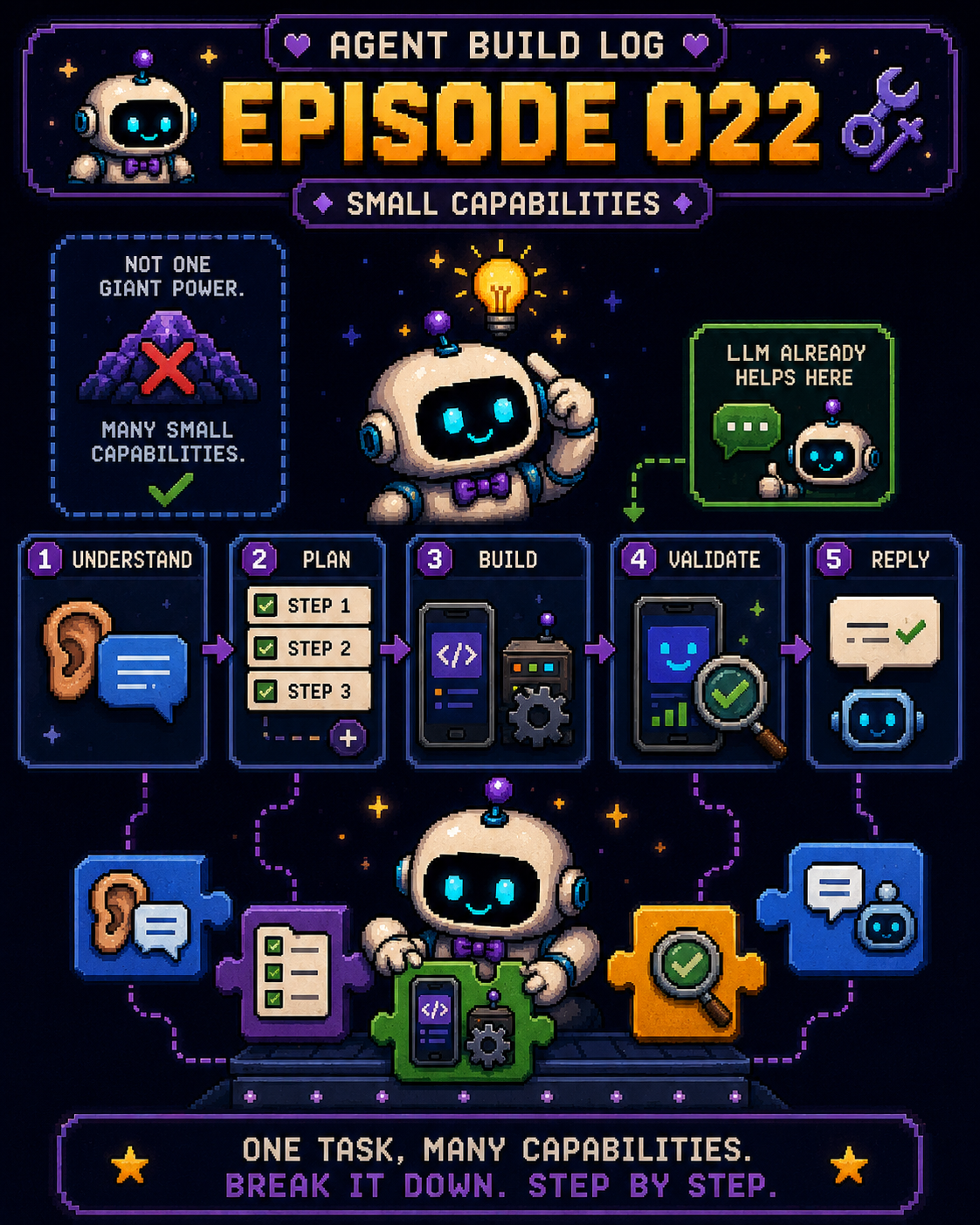
If you break down the daily work of a software developer, completing a single task actually requires many different small capabilities.
First, there are the basic language skills: listening, speaking, reading, and writing.
A developer needs to understand what other people are saying, read and interpret requirements, and clearly communicate their own understanding, questions, and results.
Then, after receiving a requirement, they first need to understand the actual problem behind the words.
Next, they turn that requirement into prompts or notes that can be used during implementation, and break the whole task down from Step 1 to Step N.
After the implementation is complete, they still need to build the App.
They should not only check the parts they changed, but also walk through the related features and the user’s main happy path to make sure the new changes have not broken the existing flow.
Finally, they need to reply to the stakeholder and explain that the task is complete, what was implemented, and how the result can be verified.
Once I broke the process down into these steps, I suddenly realized:
These small, step-by-step capabilities are exactly the Agent capabilities I need to build.
Some of them are already available in today’s LLMs, so I do not need to implement them again.
For example, understanding natural language, organizing information, and turning a requirement into an initial set of steps.
What I actually need to do now is clearly plan the remaining small steps.
As long as I define these capabilities one by one, Pi Agent will be able to understand how far the task has progressed and turn the current result into the next action.
I had been wondering which powerful capability the Agent was still missing.
But today, I realized that I may not need to find one big capability first.
What I really need to do is break down the process of completing a developer task into small steps that are clear enough.
Then let the Agent walk through them, one step at a time.